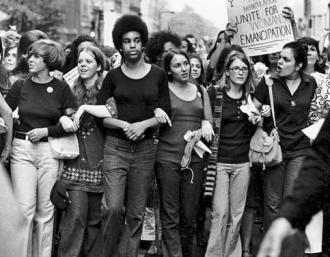
Friday, April 26, 2013

The End....


    We have all learned a lot doing these posts. Crystal was initially unsure of what gender had to do with anti-war/peace movements. But after researching the topic she discovered that women during World War II basically had to hold society together while the men in their lives were at war, then had to take care of injured men when they returned while still maintaining their family lives. She also learned how women organized movements and protests in the Vietnam era. She also learned a lot she didn't know about how members of the LGBT community influenced anti-war/peace movements throughout history.  These are all things she never would have known had she not participated in this research blog.
    The picture Monique posted was particularly interesting because it shows a woman, possibly in a state of Nirvana, breaking free of the social restrictions that society has put on her. This was a good visual representation of what we have all learned about feminism. As Monique said in her posts feminism is not about hating men, it is about accepting that women and men are equal. Women must not believe that they are predestined to behave a certain way or follow a certain path because of the sex under which they were born.
    We all found Taylor’s post to be pretty touching because it showed that someone who comes from a religious background can still be accepting of the ideas of people who identify as members of the LGBT community. The picture of Taylor with her brother was cute, and it showed how close she is to him and how much love there is in her family. It is a nice idea that someone can come from a religious background and still love and accept others for who they are. We all learned in general how prejudice and the ideas of societal norms can keep society from advancing, but how the actions of a few people in the past have allowed us to be able to move forward and become who we are today.
    The reason that these topics matter is because we have all learned that to move forward people must stand up for what they believe in. Whether it is feminism, women’s rights, or LGBT rights. Everyone deserves to live in a society where they are equal and accepted for who they are. The general idea of this blog was to compare past events to the present and see how much progress we have made when it comes to how we view and treat each other. We believe that we have shown how much of a difference people have made in the past when they have stuck together, and that what people are doing now will continue to gain rights for future generations. We hope that whoever has read this blog has learned something from it, and found the concepts as interesting as we did. Thanks for reading!

Crystal and Monique

Gays and Lesbians Peacefully Protesting


As I set out to research this topic, I realized there is more out there about this subject than I ever realized. Quite frankly, I am surprised that I didn’t know about all of the gay and lesbian people who were involved in anti-war and peace movements until now. Because I found so much information on this topic, I am going to try to include a little bit about how members of the LGBT community impacted historical events from the 1920’s to one of the most recent wars in Iraq.
The article “Peace Activism and GLBT Rights” from the journal Gay & Lesbian Review talked about the involvement of gay and lesbian figures in anti-war demonstrations and protests. The War Resisters League, or WRL, was founded in 1923 by two lesbians named Tracy Mygatt and Frances Witherspoon. The main reason that these women formed this league is because they did not agree with the events that took place during World War I. These were together for over sixty years and were very involved in peace movements and social justice activism.
Bayard Rustin was a gay African-American peace activist who did not respond to a draft summons and ended up in prison for over two years because of it. He did not do this because he was afraid to go to war. He did this because he did not believe in the violence and the death that war brings. In 1953, he joined the WRL staff and ended up working there for over ten years. Rustin “helped launch the social justice magazine Liberation, which published works by queer pacifists such as Paul Goodman.” Queer pacifist were homosexuals who were opposed to war and tried to communicate their feelings to others through writing, which is obviously one of the least violent ways a person can express their feelings.
During the Vietnam War period a protest occurred at the Whitehall Street Induction Center in Manhattan. It happened in the year 1964 and was organized by homosexuals to show “their disgust and objection to the Vietnam War and their anger toward openly gay soldiers being given what was called a ‘blue discharge.’” (A blue discharge meant that they were dishonorably dismissed for homosexual acts or for being homosexuals). This was a situation that divided some of the “homophile groups” because some of them wanted to focus on protesting that homosexuals were being kicked out of the military, while others thought that protesting the war itself was the most important focus.
The article “Anti-War Movements” from the journal Parameters discusses the formation of a group in the 60’s called the Gay Liberation Front, or GLF.  According to the article: “In April 1971, gay liberation groups in fourteen states and more than fifty cities endorsed contingents for massive bicoastal antiwar protests in Washington, D.C., and San Francisco. In what The Advocate called ‘one of the largest concentrations of gay power ever assembled’." Three thousand gay people were involved in some of the smaller anti-war protests carried out by this group, and one of their protests, which took place in Golden Gate Park, involved around 10,000 members of the LGBT community.
     In the year 2003, ten million people protested against the Bush administrations plan to attack Iraq. According to the article: On March 20, the day after the invasion of Iraq began, GLBT people were well represented among the thousands of activists who participated in direct action and civil disobedience in Chicago, New York, San Francisco, and elsewhere. This showed me that, even though it may not be a highly-publicized aspect of peace protests, members of the LGBT community have been involved in them throughout history, and will probably continue to do so in the future. Many anti-war groups that involve members of the LGBT community still exist today, and will probably continue to exist in the future. Especially since there are so many people who are homosexual or transgender and are opposed to war and the way the military treats members of the LGBT community.

              -Crystal Feska-

                                 
                          Works Cited

Hailey, Elizabeth. "Peace, Activism, and GLBT Rights." Gay &
Lesbian Review 11.5 (2005): 2-30. Web. 25 Apr. 2013.

Neilsen, Robert. "Anti-War Movements." Parameters 12.8 (2012):
n. pag. Web. 25 Apr. 2013.

Art By James Turrell

James Turrell is a gay artist from New York City. He created this mural which currently stands at the "Santa Fe University of Art and Design." Turrell is part of the organization The National Gay and Lesbian Task Force, which has voiced it's objection to war, violence, and the way that homosexuals are treated in the military.

I really liked this piece of art because it is simple in its design, but it sends a beautiful message. I love that it says "Eyes Open" and "Mind Open." The idea of having your mind open refers to not having an issue with homosexuals in the military, and not automatically believe everything the media says about what goes on with the military. Keep your eyes open represents the fact that you should see things for yourself before you make a decision on how you feel, and the "make art not war" section is probably my favorite. Just suggesting an alternative to death and violence. That is my interpretation of the mural.
Maybe yours is a little different? One of my favorite things about this piece is that it can probably be interpreted in more ways than one, that's what makes it so interesting.

-Crystal Feska-


An Anti-War Poem: Written by a Lesbian Member of the Military

Hey guys. As the title says, this is a poem that was written by Adelina Anthony. She is a lesbian who is a member of the military, and was dishonorably discharged before the "Don't Ask Don't Tell Policy" was revealed. Having seen the horror and violence that takes place during war, Adelina is now an anti-war activist. As I have mentioned in my second research post, Adelina is one of the people who is opposed to war because of the violence and because of the way that homosexuals are treated by the military.

WARNING: The language is extremely graphic, but she makes some excellent points!


Tuesday, April 23, 2013

Sexuality and the Military Today


My first entry discussed how gender impacted the anti-war peace movements that took place during The Vietnam War, and World War II. The previous entry also discussed how gender impacted social situations, and the anti-war peace movement, but did not discuss too much about the idea of sexuality. Today, sexuality plays a huge role in the way that our military handles things. This is especially true when it comes to concepts such as The Don’t Ask Don’t Tell Policy, and current military policies regarding the treatment of homosexual couples.
One of the main ways that the idea of sexuality ties into the military in modern times is the “Don’t ask don’t tell” policy. The title of this policy is fairly self-explanatory. It was enacted on December 21, 1993 and was the “official United States policy on gays serving in the military.” The basic idea of DADT was that people who wanted to serve in the military were not asked to disclose their sexuality, and as long as they were not openly gay or lesbian they were allowed to serve. According to the article  "Don’t Ask, Don’t Tell: A Dying Policy on the Precipice" from the academic journal Scholarly Works: the policy prohibited “people who demonstrate a propensity or intent to engage in homosexual acts from serving in the armed forces in the Unites States because their presence would create an unacceptable risk to the high standards of morale, discipline, and unit cohesion that are the essence of military capability.” That is a pretty long-winded way of saying that men and women may be distracted by, and uncomfortable about, the idea of serving with gays and lesbians in the military. The language of this policy made it sound as if those who wrote it had the best interest of military members at heart, but in reality it was just a way to openly discriminate against people for their sexuality. There’s really not much of an excuse for it. I find it disgusting that our military would have openly discriminated against members of the LGBT community in such a fashion. Luckily though, the policy was repealed on September 20, 2011. Ultimately the policy didn’t really make much of a difference because people who were homosexuals never mentioned in the past. In essence this means that for years and years gays and lesbians were serving in the military but just kept it a secret. All the policy really did was give members of the military legal grounds to dismiss homosexuals. I personally am glad that it was repealed. To openly discriminate against homosexuals in this way is a violation of their constitutional rights and should not be an act carried out by such an important part of our government.
Current policies regarding homosexuals in the military are constantly changing. One of the huge debates that is currently taking place is what to do about homosexual couples who are in the military and have partners that are not. An article in The New York Times titled: “Military Benefits to Be Extended to Homosexual Couples” discusses the mess that is going to be created when it comes to deciding whether or not homosexual couples in the military are able to receive the same benefits as straight couples. The article also discussed the idea of how military benefits would work for military members who are in legal homosexual marriages. One of the ideas that was presented in the article is that if gay marriage is legalized in certain states, military members from that state would be able to give their same-sex-spouse benefits that heterosexual couples get. The issue with that idea is that people in homosexual relationships from states that do not allow same sex marriage are being blatantly discriminated against. The other question brought up in this article is whether or not people who have been in the military from states that have not previously allowed gay marriage, but do now, are entitled to back benefits. I personally believe that everyone who has not received benefits should be entitled to them for however long they served, and that since the government is not supposed to discriminate against people based on sexuality all homosexuals in the military should receive benefits for their partners. It is an interesting situation, and I suppose that only time will tell how it will all pan out. According to the article, “it seems that things are heading in a direction where it will be ‘all or nothing’ when it comes to benefits for military members who are in homosexual relationships or marriages.” I also tend to believe that we are finally headed in a direction that will allow all people in the military to be treated equally and that, ultimately, the military would not give zero benefits to married homosexual couples- and would then have to extend the same benefits to all homosexual couples. It is going to be extremely interesting to see where things go from here. 

-Crystal Feska- 

Works Cited

Correales, Robert I., "Don’t Ask, Don’t Tell: A Dying Policy on the Precipice" (2008). Scholarly Works. Paper 90.
http://scholars.law.unlv.edu/facpub/90


"Military Benefits to Be Extended to Same Sex Couples." New
                        York Times. N.p., 25 Mar. 2012. Web. 20 Apr. 2013.


I think this video is a really good note to end my blog on. This video helps to clarify what a feminist is. They're not man hating, hairy legged people. They are people of all genders, sexuality, and races. Feminist fight for equal rights. Feminist don't think women should be treated differently, or better than anyone else, they believe that women should be treated equally to everyone else. This video is a good example of what a feminist is in our day in age. Feminist now days are people who recognize our past, and fight to keep the movement rolling. This video does a wonderful job of defining what  feminism is and what feminist do.

Monique Domas. 

The light within


I was just at home enjoying my own personal blog, on tumblr and I came across this picture. It really spoke to me in a way. I linked it my blog topic feminism because the picture is portraying a beautiful women trying to break the strains of society. The caption below the picture was really touching because it explains how women are put inside of containers and forced to fight the mold. The caption writes about how sometimes we don't know how to break free from our containers, so we conform to them. I think feminist DID break out of the container. Feminist fought for the freedom and rights of every women. They wanted everyone women to recognize the light within them, and to set it free.
Monique Domas.


Tuesday, March 19, 2013

Women Worker Rights: Those for and against Feminists Movements

One thing that most people have in common is the need for money. How do most of us get that money? Through working and getting a pay check. Compared to historic times, us millenniums have it pretty nice when it comes to worker rights. This isn't true for all countries so were lucky, but women in America were not always lucky. Feminists began to fight for women's rights through out the 1960's but it wasn't until the 1970 that the government really stepped in.


It was not until around the 1970's that the government began to take the feminist movement and women's rights serous. Feminist supported both democratic and republican political parties so both parties saw it in there interest to support the feminists. "Successive presidents, beginning with Kennedy in 1963, and including Nixon, Ford, and Carter, found it politically advantageous to appoint various task forces and advisory committees on women, helping to elevate the concerns of women to the national level and spurring the passage of progressive legislation" Vicki Lens the author of "Reading between the Lines: Analyzing the Supreme Court's Views on Gender Discrimination in Employment, 1971-1982" writers in his article. So the government began to listen to feminist concerns and started to considered them as an important work force.

Soon after, feminist saw victory. Any example would be the Title IX of the Civil Rights Act. The title "prohibited sex discrimination in any educational programs that receive federal funds" according to Lens. So women were now able to get an education through government funded programs. This allowed women to have the opportunity at higher paying, male dominant careers. The Science and Engineering Equal Opportunities Act of 1980 was passed in hopes to encourage women to go into science and engineering fields which were male dominate. Women were also allowed to join the military which was a big step for feminist. Lens supports this by writing in his article "enlistment quotas for women were lifted, women were allowed to enlist at the same age as men, and they were granted permission to enter military academies".

Things were looking up for feminist but not for long. As the feminist and women were gaining more and more rights opposers began to form there own organizations against women. Lens explains that " the success of the Equal Rights Amendment in Congress, which passed the House and Senate in 1972 with overwhelming majorities, sparked an antifeminist movement that helped ultimately defeat it in the states". Not everyone was for women rights and the congress and politically parties saw that. At the start both democratic and republican parties were for women rights, but by the 1980's neither parties really supported the feminist movement and women rights.  Thats not to say that no one was rooting for the feminist but there were many people and organizations that had issues with some of the acts passed for women's rights.

Phyllis Schlafly

An example would be Phyllis Schlafly. Her main focus was against women in the military.  At first she wasn't totally against the idea but later on her opinion changed. Marley and David John wrote an article called "Phyllis Schlafly's Battle Against the ERA and Women in the Millitary". In the article, I learned a lot about Schlafly and how she worked against women being in the military. Marley and David wrote that "Schlafly's concerns about women in combat could be put into four categories. The first area covers motherhood, childbearing and combat readiness. The second is her views on the physical strength of women in performing combat roles. Next is the drafting of women. The fourth is sexual harassment of women, including their treatment as prosiners of war". She used these four points to try and encourage people to be against women in the military. She mainly fought against feminists and women's rights in terms of women being in the military.


Schlafly says "Our young women have a right to be feminine," and those rights will not be abandoned as Schlafly put it, "because a handful of women, unhappy with their gender, want to be treated like men". I think its important that we look at the people fighting against the feminists because we can't truly appreciate or understand how we got to the point were at today without looking at the struggles. I think that Schlafly has some very good points that are important. Even though she does deem women as being less than men in certain aspects, she has some very interesting ideas. She was successful at altering people's opinion about women in the military. Schlafly is a good example of an anti-feminist activist.

Even when the going got tuff, people came together and made things work. The rights we have as women today were not given but earned. I think its important to look back into history and understand not only the good things that happened but the bad things that came along the way too and the feminist movement and the fight for women worker rights is a wonderful example. From big powerful sources like the government to a single women named Phyllis Schlafly, feminists fought through it all. I hope that you learned something new about the history of feminism and the struggles that came along the way.

Works cited 

Marley, David John. "Phyllis Schlafly's Battle Against the ERA and Women in the Millitary" Minerva. 18.2 (2000): 17. Web.

Vicki Lens. "Reading between the Lines: Analyzing the Supreme Court's Views on Gender Discrimination in Employment, 1971-1982." Chicago Journals 77.1 (2003): 25-50. Web.

Monique Domas

Tuesday, March 12, 2013

Gender, Sexuality, and Anti-War Peace Movements: World War II and Vietnam


      My initial reaction to the idea of how gender and sexuality connect with anti-war movements was that they didn’t really have anything to do with each other. However, after doing research on the topic I realized that I was not entirely accurate in my assumption. During World War II and the Vietnam War women took on social roles that were not commonly expected of them, and women became very involved in organizational protests and peace movements.  
      The article "A New Decade for the American People" was written by a History Channel correspondent named Bryon White. In an article he wrote for the academic journal The WWII Experience he outlined what life was like for women prior to, and during, World War II. In the 1930s we lived in a society where very specific social roles were expected of men and women. Men worked and supported their entire family financially, and women were expected to stay home, cook and clean, and care for children. In 1939 World War II began, and the social structure of America changed quite quickly. Many men went off to fight in the war and the women were taking on the roles of men (working to support their family financially), in addition to doing their regular tasks that maintained their households. There were even situations where women were working in factories to help make weapons. Bryon White's article made it very clear that this was not a traditional task for females. Usually women didn’t work period. But for women to be working jobs in factories and creating weapons was an entirely new concept. Many of the women during this time period believed that once their husbands returned from the war everyone would return back to their traditional roles, but they did not take into account death and injury. For the women whose husbands were severely injured in the war, the women still had to work, take care of children, and maintain the household but they also had the responsibility of taking care of an injured husband thrown on top of those things. For the women whose husbands were killed in the war, they were put in a situation where they would not be able to only stay at home and care for children unless they remarried. In both of these cases women had to take on the roles of men, and they had to adapt to learning to work and care for their families.

This photo shows women working in a weapons manufacturing factory while their husbands were fighting WWII
     According to wikipedia.com: the Vietnam War began in the year 1945, but the United States soldiers were not physically involved in fighting the war until the early 60s. Prior to the Vietnam War the way that people got information was over the radio where they could only hear broadcasts with no physical images to associate the words with. But by the time that the United States got involved in The Vietnam War, people were able to see what was going on in Vietnam. The online article "The History of Vietnam" discussed the fact that, unlike with previous wars, there was a visual representation of the violence that was taking place of people losing their lives, and of how bloody and awful the situation was. People seeing these images for the first time became extremely upset and they did not want to support soldiers fighting anymore. This lead to the formation of protest groups all across the United States. The article about the history of the Vietnam War also did a great job of outlining the roles that women played in organizing protests, and explained that it was a situation where women became extremely involved. Women created signs, participated in the rallies that took place, recruited members, and kept things organized. Women were an extremely important part of the process, and the men may not have been able to handle all of the work that goes into protests on their own. The fact that women were involved in these protests was interesting because women were still in a situation where they were expected to behave and act a certain way. Women being out and physically protesting the war took time away from them being at home and caring for their children, which a lot of men during that time seemed to take a serious issue with. I personally have a great deal of admiration and respect for these women because even though their husbands and other male family members disagreed with their actions, they stood up for what they believed in. It has been said that the protests against the Vietnam War involved more people than any other peace movement in our nation’s history, and that it involved more women than any other peace movement. I found these things to be very interesting, and before I did my research I had no idea how important women were when it came to the earlier wars that our military has been involved in.

This photo shows people, mainly women, in the act of protesting the Vietnam War. 


                                                            Works Cited
"History of Vietnam." Wikipedia. Wikimedia Foundation, 21 Mar. 2013. Web. 21 Mar. 2013.      
     <http://en.wikipedia.org/wiki/History_of_Vietnam>.
Vietnam History, People, Economy, Geography, Government." Vietnam History, People, Economy,   
     Geography, Government. N.p., 07 Sept. 2012. Web. 21 Mar. 2013.    
     <http://vietventures.com/Vietnam/history_vietnam.asp>.
White, Bryon. "A New Decade for The American People." History.com. A&E Television Networks, 
     15 Jan. 2008. Web. 21 Mar. 2013. <http://www.history.com/>.
"Women in WWII." Women in WWII. N.p., 11 Mar. 2012. Web. 21 Mar. 2013.   
     <http://www.womeninwwii.com/>.
                                                            Crystal Feska