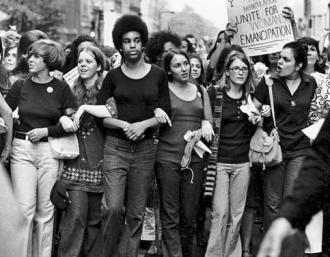
One thing that most people have in common is the need for money. How do most of us get that money? Through working and getting a pay check. Compared to historic times, us millenniums have it pretty nice when it comes to worker rights. This isn't true for all countries so were lucky, but women in America were not always lucky. Feminists began to fight for women's rights through out the 1960's but it wasn't until the 1970 that the government really stepped in.
It was not until around the 1970's that the government began to take the feminist movement and women's rights serous. Feminist supported both democratic and republican political parties so both parties saw it in there interest to support the feminists. "Successive presidents, beginning with Kennedy in 1963, and including Nixon, Ford, and Carter, found it politically advantageous to appoint various task forces and advisory committees on women, helping to elevate the concerns of women to the national level and spurring the passage of progressive legislation" Vicki Lens the author of "Reading between the Lines: Analyzing the Supreme Court's Views on Gender Discrimination in Employment, 1971-1982" writers in his article. So the government began to listen to feminist concerns and started to considered them as an important work force.
Soon after, feminist saw victory. Any example would be the Title IX of the Civil Rights Act. The title "prohibited sex discrimination in any educational programs that receive federal funds" according to Lens. So women were now able to get an education through government funded programs. This allowed women to have the opportunity at higher paying, male dominant careers. The Science and Engineering Equal Opportunities Act of 1980 was passed in hopes to encourage women to go into science and engineering fields which were male dominate. Women were also allowed to join the military which was a big step for feminist. Lens supports this by writing in his article "enlistment quotas for women were lifted, women were allowed to enlist at the same age as men, and they were granted permission to enter military academies".
Things were looking up for feminist but not for long. As the feminist and women were gaining more and more rights opposers began to form there own organizations against women. Lens explains that " the success of the Equal Rights Amendment in Congress, which passed the House and Senate in 1972 with overwhelming majorities, sparked an antifeminist movement that helped ultimately defeat it in the states". Not everyone was for women rights and the congress and politically parties saw that. At the start both democratic and republican parties were for women rights, but by the 1980's neither parties really supported the feminist movement and women rights. Thats not to say that no one was rooting for the feminist but there were many people and organizations that had issues with some of the acts passed for women's rights.
 |
| Phyllis Schlafly |
An example would be Phyllis Schlafly. Her main focus was against women in the military. At first she wasn't totally against the idea but later on her opinion changed. Marley and David John wrote an article called "Phyllis Schlafly's Battle Against the ERA and Women in the Millitary". In the article, I learned a lot about Schlafly and how she worked against women being in the military. Marley and David wrote that "Schlafly's concerns about women in combat could be put into four categories. The first area covers motherhood, childbearing and combat readiness. The second is her views on the physical strength of women in performing combat roles. Next is the drafting of women. The fourth is sexual harassment of women, including their treatment as prosiners of war". She used these four points to try and encourage people to be against women in the military. She mainly fought against feminists and women's rights in terms of women being in the military.
Schlafly says "Our young women have a right to be feminine," and those rights will not be abandoned as Schlafly put it, "because a handful of women, unhappy with their gender, want to be treated like men". I think its important that we look at the people fighting against the feminists because we can't truly appreciate or understand how we got to the point were at today without looking at the struggles. I think that Schlafly has some very good points that are important. Even though she does deem women as being less than men in certain aspects, she has some very interesting ideas. She was successful at altering people's opinion about women in the military. Schlafly is a good example of an anti-feminist activist.
Even when the going got tuff, people came together and made things work. The rights we have as women today were not given but earned. I think its important to look back into history and understand not only the good things that happened but the bad things that came along the way too and the feminist movement and the fight for women worker rights is a wonderful example. From big powerful sources like the government to a single women named Phyllis Schlafly, feminists fought through it all. I hope that you learned something new about the history of feminism and the struggles that came along the way.
Works cited
Marley, David John. "Phyllis Schlafly's Battle Against the ERA and Women in the Millitary" Minerva. 18.2 (2000): 17. Web.
Vicki Lens. "Reading between the Lines: Analyzing the Supreme Court's Views on Gender Discrimination in Employment, 1971-1982." Chicago Journals 77.1 (2003): 25-50. Web.
Monique Domas


